Friday, August 24, 2018

Wedding Spoons

One of the challenges of sorting through the estate of family members that loved buying antiques is figuring out which items are actual family memorabilia and which items are just things they picked up at flea markets and junk stores.

When we were sorting through everything, we spotted the monogrammed H on a pair of tarnished spoons and set them aside in case the H stood for Harmon. The spoons had a date engraved on them, which we figured would help us decipher their history.


Since then, as I've been working through the family archived and genealogy, I've become familiar with the significant dates in the Harmon family tree. When I looked again at the spoons last weekend, I immediately knew what they were.

The date engraved on the spoons is September 19, 1906 (9.19.06). That's the day that Edward Harmon married Mollie Carson in her parent's home at Hughesville, Missouri. Ten years later, Mollie gave birth to their only child, James, who would eventually become my grandfather.


Hughesville, Missouri today is a tiny village, with fewer than 200 people. It was founded in 1871, located on a branch of the Missouri Pacific railroad line, with a small post office and general store. During its early years, the village's prominent citizens included immigrants from Scotland and Germany, as well as migrants from Eastern states like Kentucky.

Mollie's father, James Carson, was an Irish immigrant who worked as a farm laborer in Hughesville (1900 Census). Her mother, Narcissa Garner Carson, was only 15 when the couple married in 1860. Mollie, in contrast, was 28 when she married Edward Harmon (who was 38 and divorced).

Edward Harmon's father owned a farm near Kansas, Illinois. Edward and Mollie set up their own home there, and Edward worked as a carpenter. He was also an inventor: he received a patent in 1907 for a Combined Dumping and Platform Elevator.

The spoons were made by the R. Wallace Company of Connecticut, founded in 1835 by Robert Wallace of Prospect, CT. The production of silver-plated flatware was big business in Connecticut during the 1800s and early 1900s, with companies in Waterbury, Wallingford, Meriden, and other cities supplying the country (and the world) with fashionable and affordable utensils.


The company that made the Harmon family spoons was R. Wallace & Sons, based in Wallingford, CT.  Flatware marked "1835 R. Wallace" was the most expensive of the Wallace line. An advertisement from 1911 claimed that the 1835 R. Wallace flatware was made with extra silver plate "on the parts most exposed to wear." (McClure's Magazine, Marketplace of the World, April 1911, p. 109)

Kansas, Illinois was a thriving village of 1,500 people in 1905 (Encyclopedia of Illinois and the History of Edgar County, Edited by H. Van Sellar, 1905). The village included a hotel, several stores, electricity and telephone service. The spoons may well have been purchased in Kansas as a wedding gift for Edward and Mollie.

Sunday, April 1, 2018

The Perils of Radio

I've finally started going through the Harmon Family archives, sorting and organizing all of the documents, photographs, postcards, and other ephemera, and getting everything placed in archival storage containers. It's a task that will likely take a few years to complete.

Among today's discoveries was a letter written in 1931 to Mollie Harmon by George M. Skinner, who taught Sunday School to Mollie's son James. Skinner apologizes for introducing young James to radio, attributing his low grades to his new hobby. The letter reads:

Thursday, August 6, 2015

Vintage Tattoo Designs

Way back when, my grandfather, Jim Harmon, was a tattoo artist. I'm not entirely certain of the time period, but I think it must have been during the 1930s, when he was in his 20s and living on his own in D.C. The first tattoo he ever created was on his thigh--an easy spot to work on, but he did it right-side-up when he was looking at it--which meant it was upside down for everyone else. He was so embarrassed, he never wore a swimsuit at the beach; instead, he always wore long pants so no one could see his mistake. I never saw the upside down tattoo on his leg, but it's one of the many stories I heard over the years.

One of the coolest things we found in my grandparents' things last year was a small three-ring notebook with 31 pages of tattoo designs drawn my by grandfather. My grandmother had kept it in a trunk full of family memorabilia. Some of the designs are classic naval tattoos, while others hint at my grandfather's interest in Surrealism.


Wednesday, January 28, 2015

James Harmon Artwork, part one

The best part of dealing with the estate last year was finding hidden family gems. I knew there was some family material stored on the trailers, and I knew that included some paintings done by my grandfather, James Harmon. I had never seen his artwork, so it was a real treat when we found it.

This is the first of several blog posts featuring my grandfather's artwork. This batch of paintings on canvas were found removed from their stretchers and rolled up together.

Self-portrait, 1941.

Friday, January 23, 2015

Benrus '50s Bling

This is one of my favorite wristwatches, not because it's of any particular importance, but because it embodies both local history and a snazzy design that is best described as '50s bling. (Or maybe late '40s bling.) I love the retro irony--today we would consider this to be a woman's watch, but when it was new, it was decidedly masculine.

Take a look at this watch. It's got a gold-plated case (plain steel on the back), encrusted with 14 fake diamonds; the dial boasts 8 fake diamonds (two are missing) and 5 fake rubies, arranged in an unabashedly tacky design. It's so camp, you have to love it.


Thursday, October 30, 2014

Dietrich and Fred Gruen

One final update regarding the estate sale: everything that was left over has been consigned to auction with Cabin Fever in Pennsylvania. It will be sold a little at a time at their monthly auctions.

My life is slowly beginning to return to "normal."

Two years ago, after completing a biography of Boston silversmith George Christian Gebelein for the German Historical Institute's online encyclopedia of German-American Immigrant Entrepreneurs, I agreed to write a similar biography of Dietrich and Frederick Gruen, founders of the Gruen Watch Company.

Being the daughter of a horologist, I felt that I was well suited to the task. I started my research with a visit to my dad's shop, where he pulled out all of his Gruen books, parts, and one lovely pentagon pocket watch that had been hidden away in a parts drawer for decades.

Gruen Pentagon Verithin pocket watch.

Monday, September 1, 2014

Stay Tuned!

The estate sale is over, but there's still a lot of great stuff left. I'll be updating this website with information about where it is being consigned as that progresses.

A few people asked what happened with the "leftovers" from the earlier sale at my dad's shop. That was all consigned to auction with Cabin Fever in Pennsylvania. They'll be selling it a little at a time every month.

Saturday, May 10, 2014

Electronics and More!

A few fun gadgets:


Multi-Speed Pentron Tape Recorder

Here's a recording device that would fit in perfectly with the first season of Mad Men. It's a Pentron reel-to-reel tape recorder, produced during the 1950s.


Pentron marketed their tape recorders for family use (because what could be more entertaining than letting the kids record their voices on an expensive new gadget?), but probably proved more useful for business meetings.


The Pentron Corporation was based in Chicago. Their slogans included "In Electronics... It's Pentron" and "There's more fun at home when you have a Pentron."


Voltmeters

You can never have too many voltmeters. What, you haven't got even one? Well, now's your chance to load up!


Most of these voltmeters were produced by Weston Electrical Instrument Corporation of Newark, N.J., probably during the 1920s or '30s. One exception is the red voltmeter, which might have been made during the 1890s.


Slide Projector

Some of you may be too young to know what this is. Before the dawn of computers and PowerPoint, people used actual physical slides that were projected through machines like this Argus 200 slide projector.


Magic Lantern

Before electricity, slides were projected using kerosene lamps inside of magic lanterns. This "Lanterne Magique" was produced by Ernst Plank, and is unfortunately missing a few parts (but is still super-cool!).


Wednesday, May 7, 2014

Treadle-Powered Saw

If you haven't seen one of these before, it might be a little surprising. We're so accustomed to power tools being powered by electricity, we've forgotten about treadles.


The Hobbies company, based in England, produced their treadle-powered fretsaws until at least the 1970s, making minor modifications to the design over the decades. It was a good choice for children, letting them learn while minimizing the risk involved.


Judging from the design of this model, called the A.I., I'm guessing it's from the early 1900s, maybe the 1920s.


Tuesday, April 29, 2014

Harmon Estate Clocks, Part 7

E. N. Welch, Forestville

First up today is a lesser-known Connecticut clock company, which began its history with Elisha Niles Welch (1809-1887), who peddled wooden-movement shelf clocks during his youth with his father. Welch eventually started the E. N. Welch Clock Company in the Forestville section of Bristol. The company continued operations until 1902, when it was bought out and renamed the Sessions Clock Company.

Sessions hit hard times during the mid-1950s and was itself bought out in 1958 by Consolidated Electronics Industries Corporation of N.Y., which kept the Sessions company going until 1968.

This is a classic ogee shelf clock, which were popular from the 1830s through the 1880s. Some continued to be made in the 1890s, but by then the "gingerbread" style of case had come into fashion. "Ogee" is an architectural term, which refers to the curve of the case border.


The lower portion of the glass front, as is expected with an ogee clock, has a painting done in reverse on the inside, so that it can be viewed on the outside. This is called reverse-glass painting, and it was often done by young women. The Connecticut clock industry was an early employer of women, who were hired to paint the dials and glass of the clocks. When Connecticut's watch industry took off, women were hired for their "nimble" and "delicate" fingers.


The scene on the glass is a view of the Alameda de Paula in Havana, Cuba. The print was published on the front page of the London Illustrated News in 1853. I don't know if it was reprinted in a U.S. magazine, or if a copy of the Illustrated News found its way to Connecticut.


The remains of the original label inside the case.


The maker's name stamped on the movement, visible through an opening in the dial.


"S" Clock Company

There are two "gingerbread" clocks in my grandfather's collection that are marked only with an S inside a circle on the dial. Is it Sessions? Is it another company?


The "S" logo is obscured by the brass ring just above the 6.


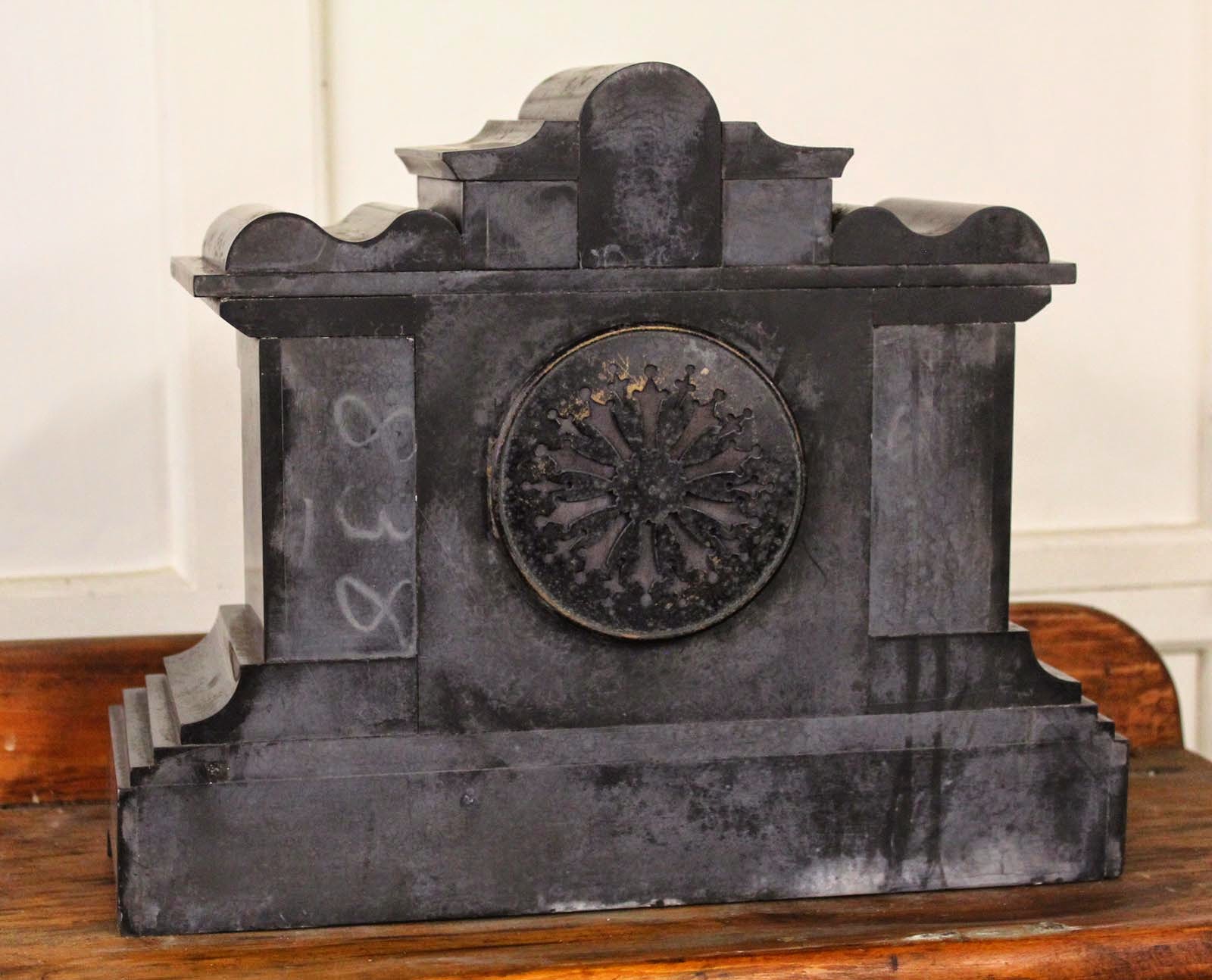
Unknown French Maker

The only identification mark that I have found on this clock is a "medaille d'argent" stamp on the movement. It could be a Vincenti & Cie, or it could be a completely different company.

The case is heavy stone, carved with decorative patterns, some inlay, and what I presume to be marble columns.

The glass has remnants of stickers, but is otherwise in good shape.
The case has sticker remnants as well and could use a little sprucing up.


Sunday, April 20, 2014

Artful Glass and Ceramics

Included in my grandparent's collection are a number of beautiful glass and ceramic objects. Here are a few of them, all of which will be available to purchase in July and August, when we have the GIANT Estate Sale. If you're planning ahead, I expect to be open for business nearly every day during those months.


One of a pair of blue vases.

The vases are signed, but I can't identify the mark. It could be a PK, or a fancy FPK, or DK.


Sunday, April 13, 2014

Radio Waves

Everyone loves an old radio, but what about an ultra short wave generator intended for medical use?


This is a Liebel-Flarsheim Ultra Short Wave Generator, model SW-400. Sadly, much of the veneer popped off from moisture on the trailer where it was stored. It also had a coating of mold growing on it and in it. I've cleaned off most of that.


The Ultra Short Wave Generator was an early diathermic device. Diathermy is used to increase blood flow and metabolism. Short wave diathermy can be used to relieve pain in deep muscles and joints: just as using a heating pad can relieve muscle tension or aches and pains, short wave diathermy applies heat to areas that can't be reached by heating pads. While this may look like a quack medicine device, it is very similar to diathermic devices manufactured today for treating rheumatoid arthritis and osteoarthritis.


The guts of the machine.

This looks like something out of a 1930s sci-fi movie.


There were a number of companies that made these devices during the early 1900s. If you want to really explore the varieties of medical devices from this era, visit electrotherapymuseum.com.

I will not be powering up this device. From what I've read, it operates on a frequency that can wreak havoc with electrical equipment.
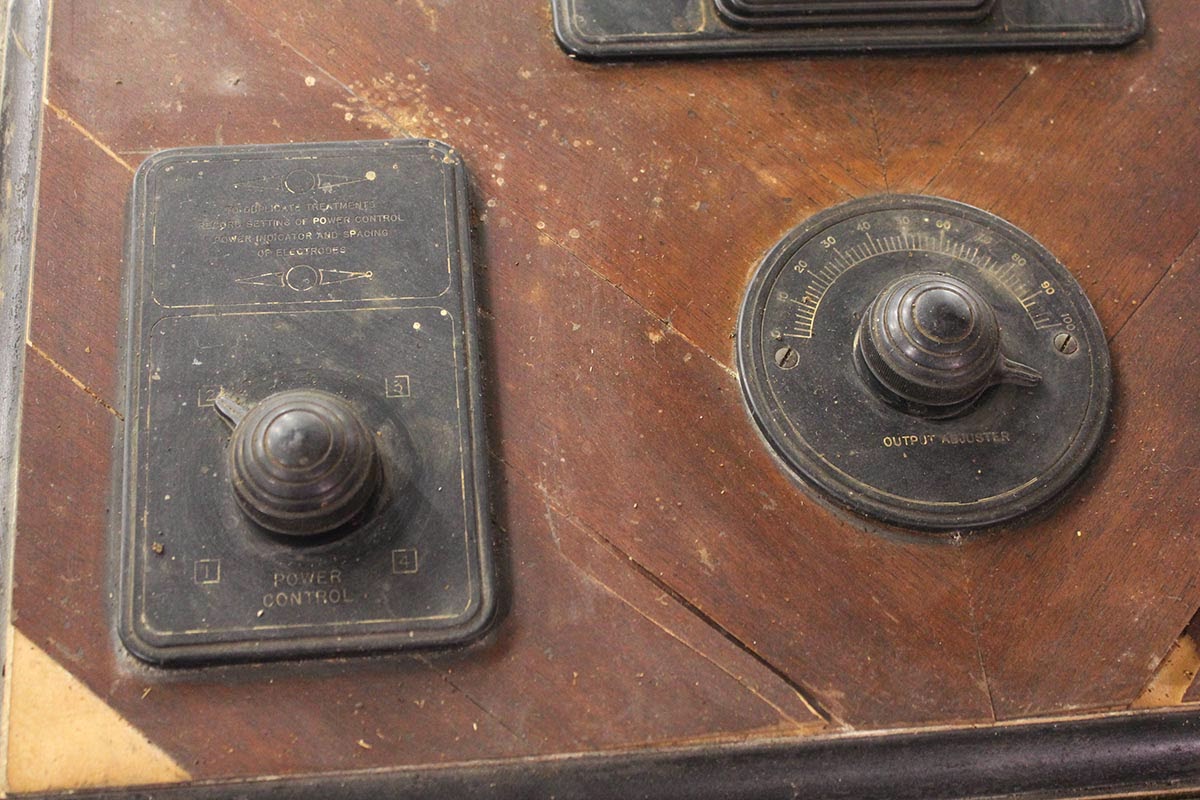
Liebel-Flarsheim also made X-ray equipment. The company was founded by John George Henry Liebel (1891-19??) and Edwin S. Flarsheim (1894-1948) in 1917. They were, and still are, based in Cincinnati, although the company now operates as a division of Mallinkrodt, which bought them in 1996.

The back of the Liebel-Flarsheim device.


Instructions for installing tubes, stapled to the inside back cover.

Inside the front of the cabinet, where the paddles are stored.

The paddles. 
Missing are the wands which could be placed on either side 
of the head or body without touching the patient.