Showing posts with label gadgets and devices. Show all posts

Saturday, May 10, 2014

Electronics and More!

A few fun gadgets:


Multi-Speed Pentron Tape Recorder

Here's a recording device that would fit in perfectly with the first season of Mad Men. It's a Pentron reel-to-reel tape recorder, produced during the 1950s.


Pentron marketed their tape recorders for family use (because what could be more entertaining than letting the kids record their voices on an expensive new gadget?), but probably proved more useful for business meetings.


The Pentron Corporation was based in Chicago. Their slogans included "In Electronics... It's Pentron" and "There's more fun at home when you have a Pentron."


Voltmeters

You can never have too many voltmeters. What, you haven't got even one? Well, now's your chance to load up!


Most of these voltmeters were produced by Weston Electrical Instrument Corporation of Newark, N.J., probably during the 1920s or '30s. One exception is the red voltmeter, which might have been made during the 1890s.


Slide Projector

Some of you may be too young to know what this is. Before the dawn of computers and PowerPoint, people used actual physical slides that were projected through machines like this Argus 200 slide projector.


Magic Lantern

Before electricity, slides were projected using kerosene lamps inside of magic lanterns. This "Lanterne Magique" was produced by Ernst Plank, and is unfortunately missing a few parts (but is still super-cool!).


Wednesday, May 7, 2014

Treadle-Powered Saw

If you haven't seen one of these before, it might be a little surprising. We're so accustomed to power tools being powered by electricity, we've forgotten about treadles.


The Hobbies company, based in England, produced their treadle-powered fretsaws until at least the 1970s, making minor modifications to the design over the decades. It was a good choice for children, letting them learn while minimizing the risk involved.


Judging from the design of this model, called the A.I., I'm guessing it's from the early 1900s, maybe the 1920s.


Sunday, April 13, 2014

Radio Waves

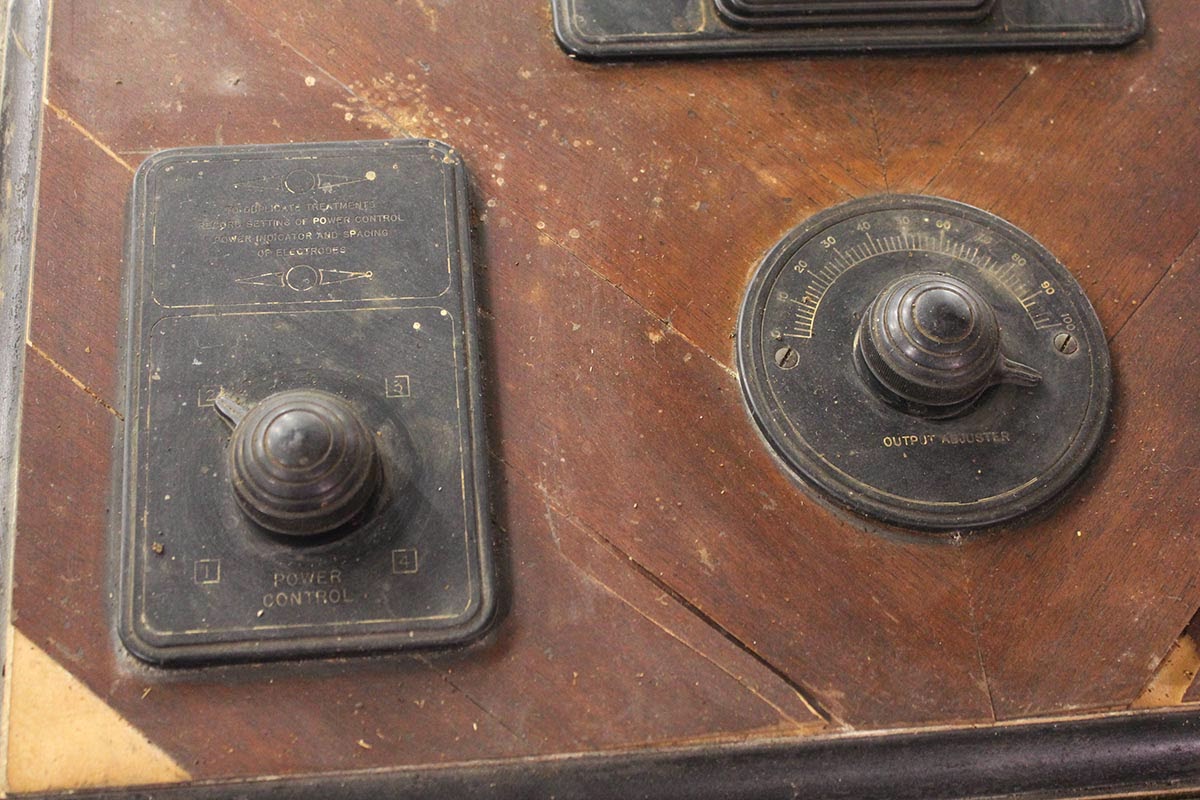
Everyone loves an old radio, but what about an ultra short wave generator intended for medical use?


This is a Liebel-Flarsheim Ultra Short Wave Generator, model SW-400. Sadly, much of the veneer popped off from moisture on the trailer where it was stored. It also had a coating of mold growing on it and in it. I've cleaned off most of that.


The Ultra Short Wave Generator was an early diathermic device. Diathermy is used to increase blood flow and metabolism. Short wave diathermy can be used to relieve pain in deep muscles and joints: just as using a heating pad can relieve muscle tension or aches and pains, short wave diathermy applies heat to areas that can't be reached by heating pads. While this may look like a quack medicine device, it is very similar to diathermic devices manufactured today for treating rheumatoid arthritis and osteoarthritis.


The guts of the machine.

This looks like something out of a 1930s sci-fi movie.


There were a number of companies that made these devices during the early 1900s. If you want to really explore the varieties of medical devices from this era, visit electrotherapymuseum.com.

I will not be powering up this device. From what I've read, it operates on a frequency that can wreak havoc with electrical equipment.

Liebel-Flarsheim also made X-ray equipment. The company was founded by John George Henry Liebel (1891-19??) and Edwin S. Flarsheim (1894-1948) in 1917. They were, and still are, based in Cincinnati, although the company now operates as a division of Mallinkrodt, which bought them in 1996.

The back of the Liebel-Flarsheim device.


Instructions for installing tubes, stapled to the inside back cover.

Inside the front of the cabinet, where the paddles are stored.

The paddles. 
Missing are the wands which could be placed on either side 
of the head or body without touching the patient.

Sunday, April 6, 2014

Trunks

Although prying open crates proved disappointing, opening the numerous trunks has been much more satisfying. Here's one I opened one yesterday.


This is one of the smaller trunks, only about knee-high in height. (I really need to keep a tape measurer on-site.)

Unlike the crates, the trunks open with ease.


It's like opening a treasure box.


This particular trunk proved to be holding four items.

A pink kerosene lantern, banged up and missing its glass.

A tiny red kerosene lantern, a little banged up, but otherwise in good shape.

A heavily shellacked print in a rustic frame.


And one clock.

The clock is a Wm. L. Gilbert "Curfew" clock. The William L. Gilbert Clock Company, based in Winsted, Connecticut, operated from 1871 until 1934. The "Curfew" was produced in a number of variations during the twentieth century; one of the unifying features was the bell on top. The "Curfew" was produced during the early 1900s.


Back of the "Curfew" clock.

"Curfew" movement.

"Curfew" dial.

A slightly blurry photo of the maker's name on the dial.

One of the clock's feet.


Although the founder of the Gilbert Clock Company was long gone by the time this clock was produced, he is an interesting character, so I've put a little bit of his story into this post.

William Lewis Gilbert (1806-1890)  grew up on a Litchfield farm, moving to Winsted as an adult. He served in the State Legislature for two terms, during which time he pushed through the charters for the Winsted Bank and for the Connecticut Western Railroad.

William L. Gilbert, from Gilbert Academy and Agricultural College, 1893


Gilbert's clockmaking career began in 1828, when he partnered with his brother-in-law, George Marsh, in Bristol, Connecticut. This new business made clock parts for Jerome & Darrow for three years, before finally manufacturing entire clock movements. They relocated to Farmington for several years.

Gilbert returned to Bristol in 1835 to start a new company, called Birge, Gilbert & Co. This was soon followed by Gilbert, Grant & Co. In 1841, Gilbert relocated again, this time to Winsted, where he purchased a clock factory. The business expanded to Ansonia from 1857 until 1862, and to Williamsburg, NY from 1863 until 1871.

Disaster struck in 1871, when Gilbert's clock factory in Winsted burned down. Gilbert turned disaster into opportunity, reorganizing his business as the William L. Gilbert Clock Company and constructing new, larger, and improved factory buildings equipped with the best machinery.

Gilbert had a side business as a banker, taking over the former Winsted Bank building in 1867. He was also involved in the creation of a railroad line from Hartford to Millerton, NY. Both banking and railroads were highly profitable ventures during the nineteenth century, and Gilbert built up a small fortune.

Gilbert was a generous philanthropist, donating $800,000 to the town of Winsted and $50,000 to La Teche Seminary Agricultural College in New Orleans, which was renamed the Gilbert Academy and Agricultural College after his death. The Gilbert Academy began as a home for African-American orphans whose fathers died fighting in the Civil War, and eventually became a private high school for African Americans.

He also built a home for orphans in Winsted, spending his last Christmas with the children of the orphanage. The Gilbert Home for Friendless Children, established after his death, took in children whose parents could not afford to take care of them. Winsted's Gilbert High School, built with his bequest, was a semi-private school that educated boys and girls from Winsted and surrounding towns.

Gilbert's clockmaking company continued after his death, until 1957, when it became a division of the General-Gilbert Corporation. The clock division was sold to Spartus Corporation of Chicago in 1964.

Friday, March 14, 2014

Veg-O-Mat Juice Extractor

At first I thought that was some sort of industrial machine, the sort of thing you'd find in a factory, or on a construction site. Then I read the label and realized it was "just" a juicer, the Veg-O-Mat juice extractor.


An advertisement from the February 1939 issue of Popular Mechanics declared "A New Industry is born! Veg-O-Mat extracts delicious vegetable juices containing all minerals, vitamins. Highly recommended by physicians."

Electric juice extractors were all the rage during the 1930s. Other brand names included Sunkist Jr. and Dormeyer. Sunkist introduced their first juice extractor in 1921, partly as an effort to increase the sales of oranges (hand-squeezing oranges at soda fountains was too laborious).

The Veg-O-Mat was marketed for home use. A pair of photographs in the March 1939 issue of Popular Science illustrated its use.

Although the brand name wasn't given, this is clearly the Veg-O-Mat.

A second illustration from Popular Science, showing the celery being fed in the top and coming out the bottom into a cloth bag.


An advertisement in the Madison Health Messenger, from about 1940 (reprinted in History of Seventh-day Adventist Work with Soyfoods, Vegetarianism...) extolled the virtues of the electric gadget:
No more laborious hand-grinding--no more dribbles of juice and waste of good fruit and vegetables. The Veg-O-Mat puts an end to the unsanitary, wasteful, and tedious old methods of juice extraction by hand. The Veg-O-Mat, a midget in size but a giant in power, comes in one compact unit which is easy to clean and economical to use. It employs the most advanced process of juice extraction, it thoroughly triturates every cell and fibre of the vegetable, and then subjects the pulp to a pressure of many tons. This insures that the juice will contain the most valuable minerals and vitamins, those found only in the interior of the fibre. Guaranteed for one year; 8 inches by 14 inches; has a capacity of sixteen to twenty pints per hour.


Here's another, very dramatic, advertisement: "Thoroughly rips every cell, subjects pulp to tons of pressure, juice contains all minerals and Vitamins." Notice that The Veg-O-Mat Machine Company also sold a "valuable booklet" on juice therapy.

Advertisement in Life & Health, The National Health Journal, May 1940.


The Veg-O-Mat was patented in April 1939 by William Wishinsky of NYC as a "Vegetable and Fruit Press."

Diagram Sheet 1 of William Wishinsky's patent (No. 2,154,649)

Wishinsky had a business supplying parts to watchmakers (hey, look! a connection to horology!), starting in 1920 or 1924. He advertised custom movement blocks and dies for platinum watch cases (among other items). His office was located at 100 West 21st Street in New York City.

Wishinsky was born on January 15, 1894 in Mlawa, Poland. He emigrated to the United States in 1913 with his mother and siblings, settling first in Boston, where he found work as a first class machinist for an electric company. In Boston, Wishinsky met his wife Rose, who came here from Russia in 1912. Both spoke Yiddish. The couple were living in Roxbury, Massachusetts when William was naturalized in 1920.

At some point between 1920 and 1923, the Wishinskys moved to New York City. They lived at 1487 Teller Avenue in the Bronx and had two sons: Jonas and Myron.

After receiving the patent for his Veg-O-Mat, William Wishinsky opened up a new office for his new business, at 655 Sixth Avenue in Manhattan. He remained at that address until the late 1950s, listing himself in the directories as a tool and die maker.

I have not found a record of William's death. Rose died in 1983.


The Veg-O-Mat was the precursor to the Veg-O-Matic, which was introduced in 1963. The invention of the famous Veg-O-Matic ("It slices! It dices!") is credited to Samuel Popeil, who moved to Chicago from New York in 1945. He introduced his Chop-O-Matic in 1956. The main difference between the Veg-O-Mat and the Veg-O-Matic is that the later, more famous gadget was manual, not electric.

I don't know what the connection is between the Veg-O-Mat and the Veg-O-Matic, other than the obvious trademark infringement with the name and general concept. The Veg-O-Mat Machine Company was still in existence in 1957, located at 655 Sixth Avenue in New York City. They were gone by 1960, which is about when Popeil applied for his vegetable cutter patent.

Saturday, March 8, 2014

Utter's Parlor Game

Sometimes you just have to know what you're looking for, and then you find it.

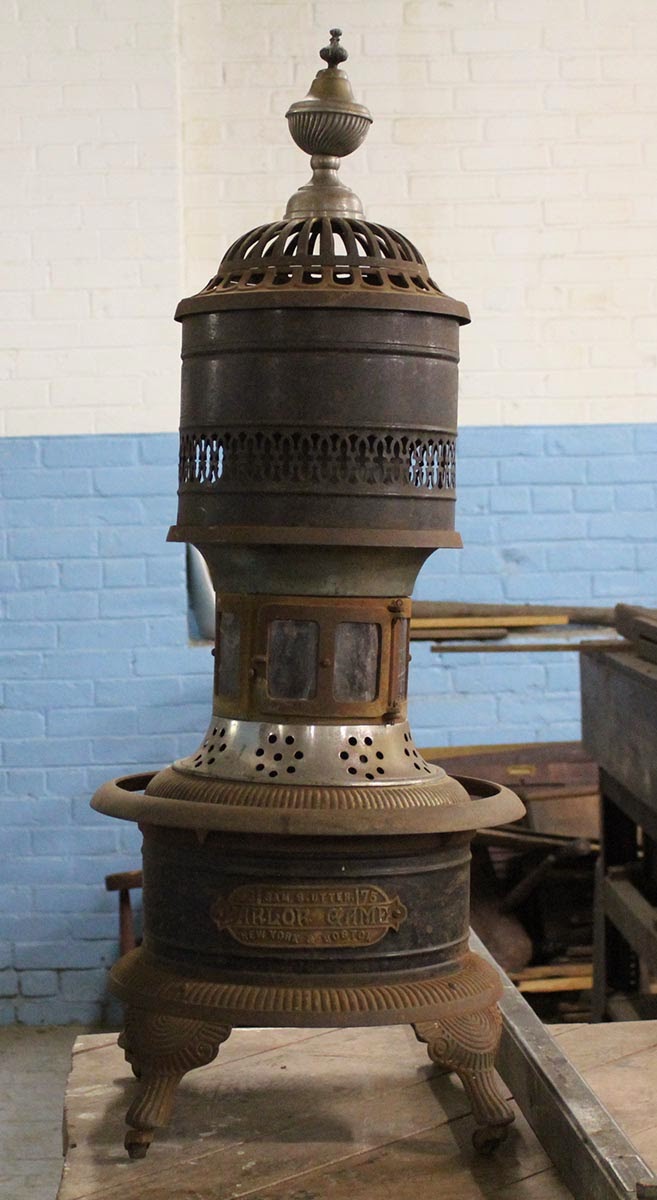
In my last post, I shared images of a whatsit device that was labeled "Parlor Game." At that point, I had found only the base. Fortunately, the base was clearly labeled with the product name and the manufacturer's name, allowing me to find this great illustration of what the complete device (a space heater) should look like.

Advertisement in The Metal Worker, 22 September 1894.

Today, as I as working on the inventory for the probate court, I suddenly realized that the missing parts of the Parlor Game were right in front of me. It's amazing how something can go from being a mysterious whatsit to an obvious and easily identified contraption.

Here is the completed Parlor Game, which comes in three sections:


The two top sections.

The burner, on the top of the base.

So what does one do with a Victorian oil heater? If you're courageous and mechanically inclined, you could fix it up and get it working again. If it gets refinished, it would make a great movie prop. Maybe there's a museum of parlor stoves. Or maybe a steampunk artist will be inspired to convert it into a fantastical device.