Showing posts with label clocks. Show all posts

Tuesday, April 29, 2014

Harmon Estate Clocks, Part 7

E. N. Welch, Forestville

First up today is a lesser-known Connecticut clock company, which began its history with Elisha Niles Welch (1809-1887), who peddled wooden-movement shelf clocks during his youth with his father. Welch eventually started the E. N. Welch Clock Company in the Forestville section of Bristol. The company continued operations until 1902, when it was bought out and renamed the Sessions Clock Company.

Sessions hit hard times during the mid-1950s and was itself bought out in 1958 by Consolidated Electronics Industries Corporation of N.Y., which kept the Sessions company going until 1968.

This is a classic ogee shelf clock, which were popular from the 1830s through the 1880s. Some continued to be made in the 1890s, but by then the "gingerbread" style of case had come into fashion. "Ogee" is an architectural term, which refers to the curve of the case border.


The lower portion of the glass front, as is expected with an ogee clock, has a painting done in reverse on the inside, so that it can be viewed on the outside. This is called reverse-glass painting, and it was often done by young women. The Connecticut clock industry was an early employer of women, who were hired to paint the dials and glass of the clocks. When Connecticut's watch industry took off, women were hired for their "nimble" and "delicate" fingers.


The scene on the glass is a view of the Alameda de Paula in Havana, Cuba. The print was published on the front page of the London Illustrated News in 1853. I don't know if it was reprinted in a U.S. magazine, or if a copy of the Illustrated News found its way to Connecticut.


The remains of the original label inside the case.


The maker's name stamped on the movement, visible through an opening in the dial.


"S" Clock Company

There are two "gingerbread" clocks in my grandfather's collection that are marked only with an S inside a circle on the dial. Is it Sessions? Is it another company?


The "S" logo is obscured by the brass ring just above the 6.


Unknown French Maker

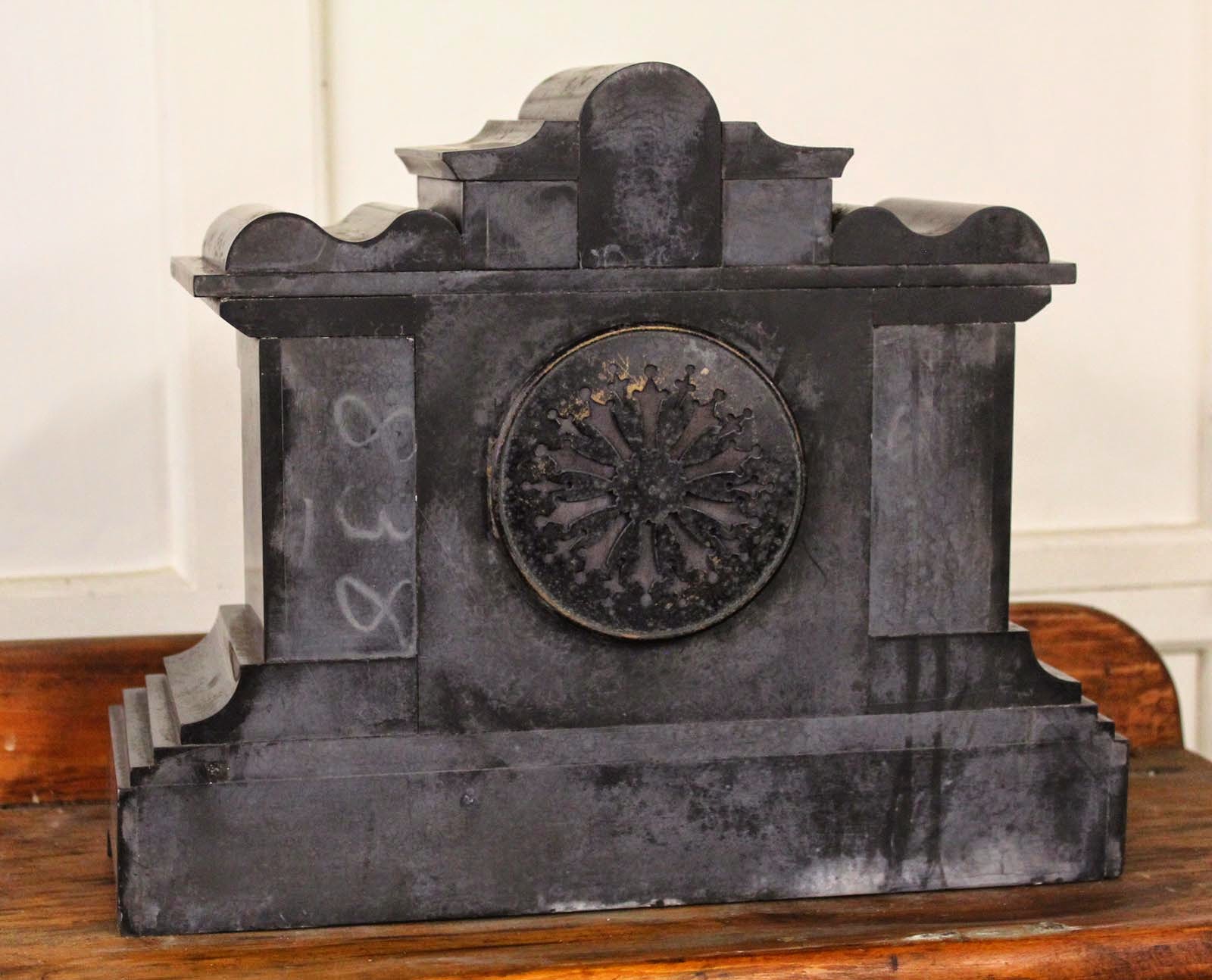
The only identification mark that I have found on this clock is a "medaille d'argent" stamp on the movement. It could be a Vincenti & Cie, or it could be a completely different company.

The case is heavy stone, carved with decorative patterns, some inlay, and what I presume to be marble columns.

The glass has remnants of stickers, but is otherwise in good shape.
The case has sticker remnants as well and could use a little sprucing up.


Sunday, April 6, 2014

Trunks

Although prying open crates proved disappointing, opening the numerous trunks has been much more satisfying. Here's one I opened one yesterday.


This is one of the smaller trunks, only about knee-high in height. (I really need to keep a tape measurer on-site.)

Unlike the crates, the trunks open with ease.


It's like opening a treasure box.


This particular trunk proved to be holding four items.

A pink kerosene lantern, banged up and missing its glass.

A tiny red kerosene lantern, a little banged up, but otherwise in good shape.

A heavily shellacked print in a rustic frame.


And one clock.

The clock is a Wm. L. Gilbert "Curfew" clock. The William L. Gilbert Clock Company, based in Winsted, Connecticut, operated from 1871 until 1934. The "Curfew" was produced in a number of variations during the twentieth century; one of the unifying features was the bell on top. The "Curfew" was produced during the early 1900s.


Back of the "Curfew" clock.

"Curfew" movement.

"Curfew" dial.

A slightly blurry photo of the maker's name on the dial.

One of the clock's feet.


Although the founder of the Gilbert Clock Company was long gone by the time this clock was produced, he is an interesting character, so I've put a little bit of his story into this post.

William Lewis Gilbert (1806-1890)  grew up on a Litchfield farm, moving to Winsted as an adult. He served in the State Legislature for two terms, during which time he pushed through the charters for the Winsted Bank and for the Connecticut Western Railroad.

William L. Gilbert, from Gilbert Academy and Agricultural College, 1893


Gilbert's clockmaking career began in 1828, when he partnered with his brother-in-law, George Marsh, in Bristol, Connecticut. This new business made clock parts for Jerome & Darrow for three years, before finally manufacturing entire clock movements. They relocated to Farmington for several years.

Gilbert returned to Bristol in 1835 to start a new company, called Birge, Gilbert & Co. This was soon followed by Gilbert, Grant & Co. In 1841, Gilbert relocated again, this time to Winsted, where he purchased a clock factory. The business expanded to Ansonia from 1857 until 1862, and to Williamsburg, NY from 1863 until 1871.

Disaster struck in 1871, when Gilbert's clock factory in Winsted burned down. Gilbert turned disaster into opportunity, reorganizing his business as the William L. Gilbert Clock Company and constructing new, larger, and improved factory buildings equipped with the best machinery.

Gilbert had a side business as a banker, taking over the former Winsted Bank building in 1867. He was also involved in the creation of a railroad line from Hartford to Millerton, NY. Both banking and railroads were highly profitable ventures during the nineteenth century, and Gilbert built up a small fortune.

Gilbert was a generous philanthropist, donating $800,000 to the town of Winsted and $50,000 to La Teche Seminary Agricultural College in New Orleans, which was renamed the Gilbert Academy and Agricultural College after his death. The Gilbert Academy began as a home for African-American orphans whose fathers died fighting in the Civil War, and eventually became a private high school for African Americans.

He also built a home for orphans in Winsted, spending his last Christmas with the children of the orphanage. The Gilbert Home for Friendless Children, established after his death, took in children whose parents could not afford to take care of them. Winsted's Gilbert High School, built with his bequest, was a semi-private school that educated boys and girls from Winsted and surrounding towns.

Gilbert's clockmaking company continued after his death, until 1957, when it became a division of the General-Gilbert Corporation. The clock division was sold to Spartus Corporation of Chicago in 1964.

Monday, March 31, 2014

Harmon Estate Clocks, Part 6

I fell a little behind with these blog posts, in order to finish writing a biography of the Gruen watchmaking family for the German Historical Institute's Immigrant Entrepreneurship online encyclopedia. Look for that later this year.

Now, time for more clocks! I've selected a few international wall clocks for this post.


England

Rombach wall clock


Thomas Rombach was a Bermondsey clockmaker, as the address boldly written across the dial indicates. Prior to 1891, he was in partnership with Adreas Saum at 215 Grange Road.


Detail of dial, showing some damage to the paint.


The label inside the case, T. Rombach, Practical Watch and Clock Maker and Jeweller, lists some of his services, including clock winding and payment plans. If I'm remembering correctly, the type of "clubs held" were buying clubs, to make it easier for consumers to buy expensive items.

The label also indicates that Rombach was servicing this clock until 1939.


Germany

Next up is a regulator from Germany. I didn't have anyone with me to hold it up, so this isn't the most flattering photograph. As you can see, there are a couple pieces near the top of the case that need to be reattached. Otherwise, though, the case is in good shape.


How do I know it's German? Well, I'm going by the letters D.R.C.M. found on the bracket holding the movement in place; except that the letters are almost certainly D.R.G.M., which was a type of patent mark used in Germany starting in 1891 ("Deutsche Reichsgebrauchsmuster"). A Gebrauchsmuster was a utility model (rather than a patent model) protecting the design or function of of an item.


One of the fun things about the internet is how easy it is to find information. Photos of a similar clock were posted in a NAWCC discussion thread. I didn't have time to take apart this clock to look for the maker's mark, but I'm going to assume from the similarities to the clock in the discussion thread, and others, that it is the same. Which means that it was made by Thomas Haller A.G. sometime around 1910.


Thomas Ernst Haller (1878-1954) came from a watchmaking family. His father, Thomas Haller (1854-1917) established his own business in the 1880s, producing pocket watches and clocks. Thomas Ernst succeeded his father in operating the Haller A.G. company.

In 1900, Haller merged with Uhrenfabriken Gebrüder Junghans. The merger lasted several years before being dissolved.

Haller A.G. was acquired by Kienzle in 1929.


Case interior, with Roman numeral markings on the lower right.

Front and back of the pendulum bob, showing a surprising amount of messy metalwork.


Japan

The third clock for this post was made by Aichi Clocks. Aichi was founded in 1892 or 1898 at Nagoya, Japan. A description of the 1903 National Industrial exhibition held at Osaka noted that Aichi Clock Company employed some 300 workers, and that there were twelve companies in the Aichi Clock Manufacturers' Guild.

Aichi produced inexpensive Western-style clocks for export. The production numbers for 1918-19 show that China was their largest export market, followed by India, the Philippines, Great Britain, Peru, and elsewhere. The United States was presumably lumped into the category of "Other countries," to which they shipped a total of 673 clocks in that year. Meanwhile, the U.S. was shipping steel springs and other supplies to Aichi.

During the early 1900s, Aichi manufactured precision equipment for the Japanese military. They became an aircraft manufacturer during the 1920s and were the fourth-largest aircraft supplier for the Japanese military during World War II. Later, after the war, they produced gears for motorcycles.
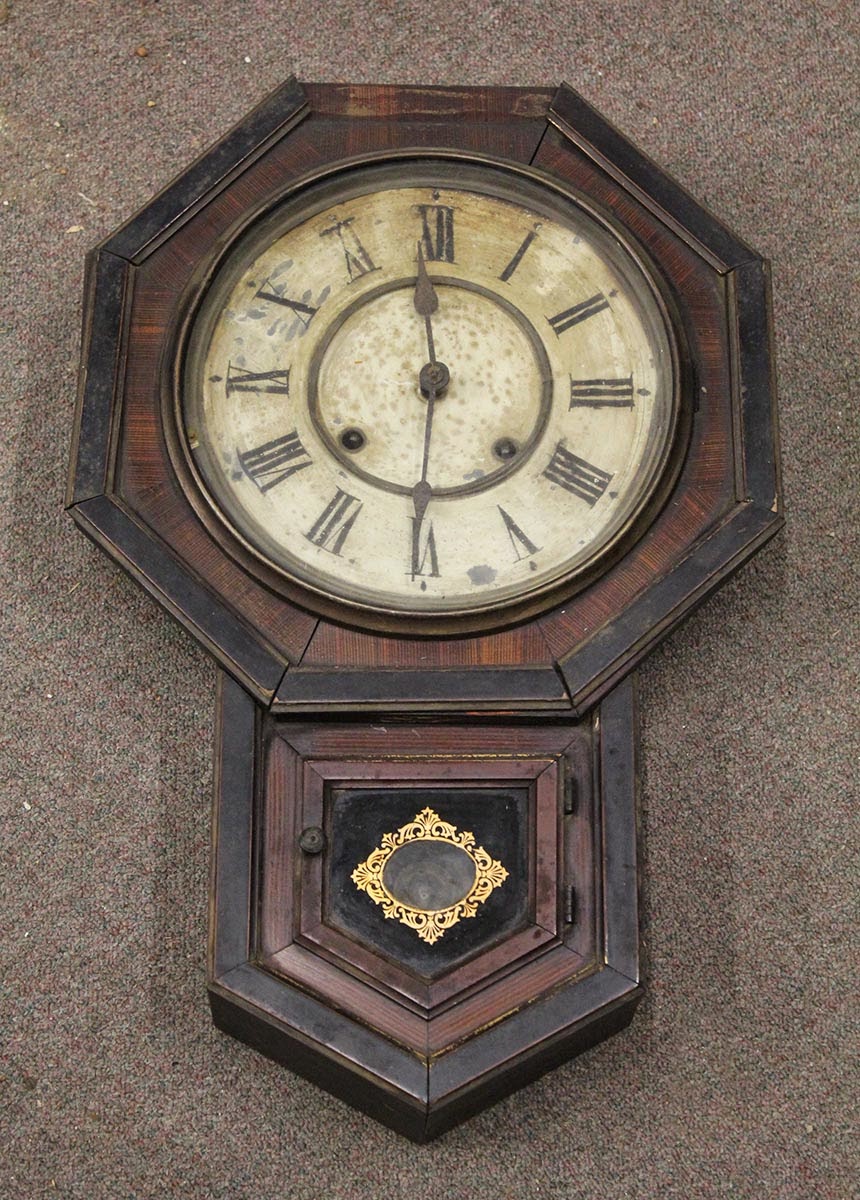
Aichi Clocks 8-day octagon regulator


The oddly-discolored paper label inside the clock.


The paper label on the back of the clock. Can anyone translate this for me?

Japan's Aichi prefecture is currently home to Naluse Company, which claims to be the only Japanese company making Japanese clocks (as opposed to Western-style clocks).


Germany?

These last two clocks are still a mystery for me. My inclination is to think they are German, but I could be completely wrong about that. [UPDATE 4/4/14: a friend of my father's has suggested that they are Black Forest clocks; after a quick search online, I have to agree.] American manufacturers produced clocks like these, but they usually stuck their name somewhere prominent on the front or back. Think about that for a moment: we take it for granted that the maker's name will appear on the face of a clock or watch, boldly turning the timepiece into an advertising poster. The Rombach at the start of this post is an excessive example, in which he's even plastered his address on the dial. We've acclimated to the hubris, but in other cultures and in other eras, it would have been considered tacky and vain to have the maker's name on the dial.

Anyway, here are the two mystery clocks. They appear to have been made by the same company. Decorative painted porcelain fronts are attached to plain wood boxes designed to hold the movements and allow you to mount the clock on the wall. Weights are not currently attached; I have three buckets full of clock weights, so I'm sure they're here somewhere.


The movement is accessed through hinged doors on either side of the clock.


The back has a hole for mounting to the wall, and what appears to be the maker's name.


I've tried to decipher the name, but so far I haven't had any luck figuring it out.


Saturday, March 22, 2014

Harmon Estate Clocks, Part 5

It seems fitting that my grandfather's clock collection includes a few Waterbury clocks, since I live in Waterbury.

Brief History

The Waterbury Clock Company was one of the major Waterbury manufacturers of the nineteenth and early twentieth centuries, originally established as a department of Benedict & Burnham Manufacturing Co. Benedict & Burnham hired Chauncey and Noble Jerome, clockmaking brothers with whom they had previously partnered, to set up their movement and case making shops during the mid-1850s.

The Waterbury Clock Company was formed in 1857 as a joint stock corporation. Noble Jerome continued as supervisor of the movement shop. Edward Church, who had worked with Chauncey Jerome for nearly two decades, took over supervision of the case shop. When Noble Jerome died in 1861, he was replaced by Silas B. Terry, son of clockmaker Eli Terry. (Silas B. Terry left the company in 1867 to form the Terry Clock Company.)

By 1868, Waterbury Clock was exporting 50,000 clocks to England every year. They were one of several Connecticut companies represented by a NYC sales agency called the American Clock Company. Sales offices in Chicago and San Francisco were opened by 1875, and an office in Glasgow, Scotland opened in 1886.

The success of the company led to it becoming independent of Benedict & Burnham in 1887. New factories and an office building were constructed on North Elm and Cherry Street in Waterbury, employing some 700 people. Further expansions during the first fifteen years of the twentieth century made Waterbury Clock the largest clock manufacturer in the country.

In 1922, Waterbury Clock acquire the Ingersoll watch company. Financial difficulties during the Great Depression led to the Waterbury Clock being reorganized as Ingersoll-Waterbury, with a shift in production to focus on electric clocks and the highly lucrative Mickey Mouse wristwatch. The company was sold in 1942 to a group of Norwegian investors, who relocated the company to the neighboring town of Middlebury. They changed the company’s name to United States Time Corporation in 1944. Clockmaking disappeared, and the company renamed itself once more, in 1969: their Timex wristwatch was so successful, they made it their corporate identity.

The Timex worldheadquarters is still located in Middlebury. Their company museum, Timexpo, opened in 2001 in Waterbury and has a comprehensive collection of Waterbury clocks, Timex watches, and related material.

The Clocks

These are wood mantel clocks, popular during the 1880s and 1890s. The first two are of a design that is sometimes referred to as "gingerbread," since they look a little bit like the cases were made out of gingerbread.

The Waterbury Clock Company had hundreds of different case designs, all of them with distinctive names. Using Tran Duy Ly's guide books, I've been able to identify only one of the clocks.


 The "Afton," 1890s.

The dial has seen better days, but is is nice to see a dial that has never been retouched.


The next clock case makes me imagine an owl spreading its wings in the night sky. It is similar to the "Hargrave," but with subtle differences in the case design, a different scene on the glass, and a different pendulum.


The pendulum is a design that was patented on March 29, 1881 by Florence Kroeber (a man, despite the name). Kroeber was a German immigrant with his own clock company in 1870, purchasing movements from Connecticut manufacturers. The main office was at 8 Cortlandt Street in NYC, next door to Waterbury Clock's New York office, at 10 Cortlandt Street.


Patent drawing for Kroeber's pendulum.


Detail of the Kroeber pendulum.


The third clock has a surprisingly plain case for Waterbury Clock Co., but the name stamped on the pendulum and the labels on the back leave no doubt as to who made it.


The dial has been poorly repaired, and is ready for more repainting.

The regulating pendulum bob, with the patent date of December 11th, 1883.